What to Know Before You Plant Peppers
One thing that I realized pretty early on in my garden, is that peppers are a long-game plant. They join the likes of onions, garlic, asparagus, and strawberries. They don’t take quite as long as asparagus but getting them going and producing it for sure a long-time coming. It’s why so many gardeners try over-wintering their pepper plants, so they don’t have to start over each year. Timing matters with peppers.
Peppers Require Early Decisions, Even If Harvest Is Far Away
Peppers don’t really “catch-up” so it’s important for you to start them from seed as soon as your planting season allows. For me, I’ll be starting my pepper seeds 8-9 weeks before last frost (which is March 26 for me). Some other seeds have some wiggle room as to when you start them (you’ll see the seed packs say to start them 6-8 weeks before last frost. There’s a 2 week wiggle space in that planting tip. However, make sure you don’t wiggle with peppers! LOL
What Peppers Need to Stay Healthy Over the Season
For every plant you plant, including peppers, you need to focus on conditions, not steps. Peppers thrive in heat. And in my growing area, we’re either full on heat in May, or slowly building to July. Depending on when our heat arrives, will depend on how quickly peppers will start putting on fruit. And that’s heat in the air and warmth of the soil. Both matter. Soil temps need to be 65˙F at minimum for transplanting, but warmer for peppers to really rock their growth.
Peppers also love water. Make sure you’re consistently deep watering your plants. Water again once you feel that the soil is dry an inch down (stick your finger in the soil and if it’s dry to your first knuckle, it’s time to water).
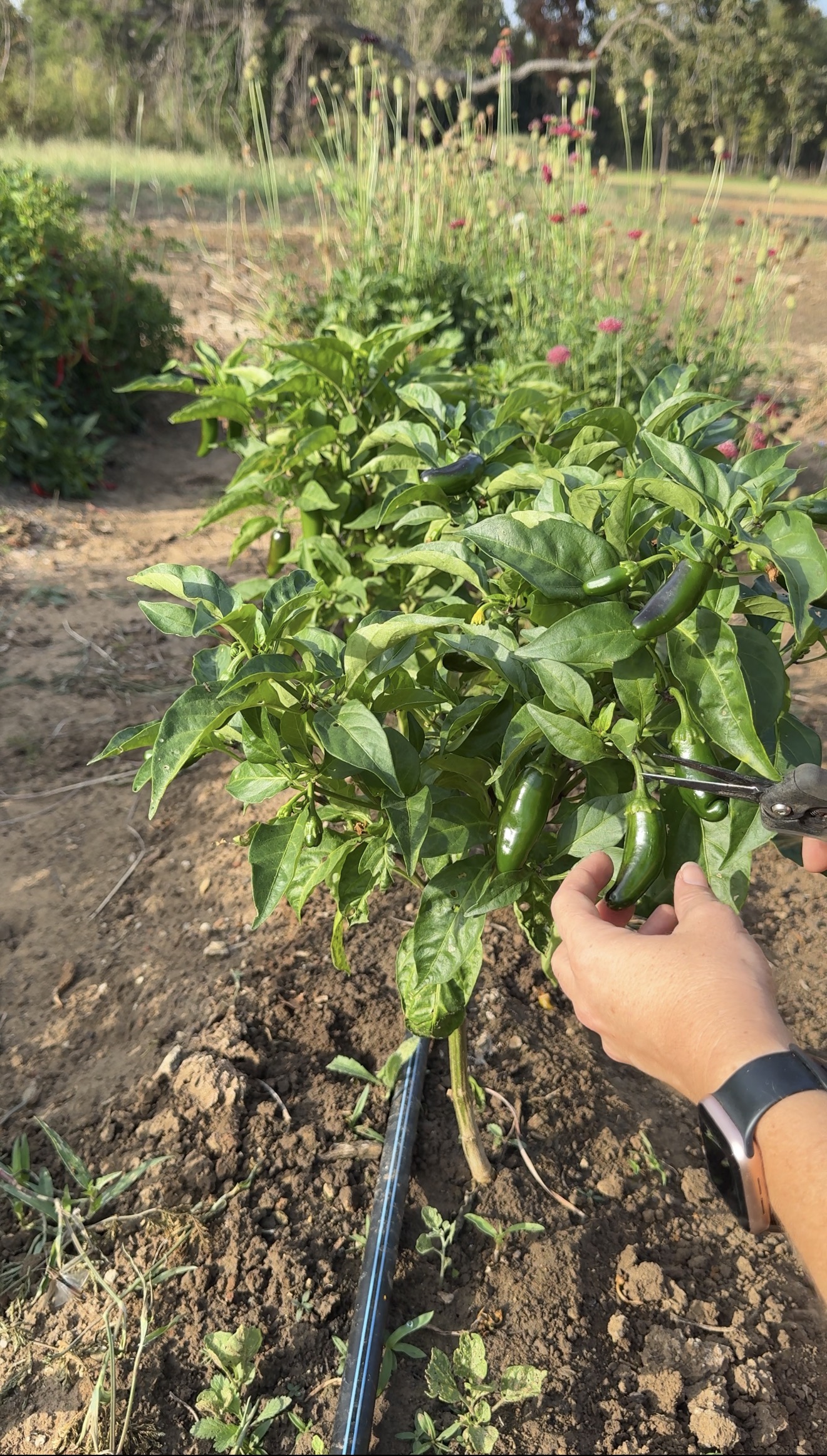
The other important aspect to peppers is their spacing between each other. Peppers turn into little trees. And they can get top heavy, so you may consider staking them with a straight stake or using a tomato cage to help them (especially if you are in a windy area). But keeping them about 18″ away from their pepper neighbors is a good rule of thumb.

Common Pepper Stress Points That Show Up Mid-Season
First issue is transplant shock. If you seed start your seeds, you have to put them through a hardening off process so they can slowly get used to your outside weather conditions. If you transplant starts from a big box nursery, you may consider some hardening off since you have no idea what the transplant has experienced from the time you received it to the time it was brought to the nursery. If it’s a local nursery, just ask someone what your options are.
Second issue is inconsistent watering. Make sure you stick to a deep water schedule. The point of deep watering, is to encourage roots to drive deep into the soil seeking water. Shallow watering keeps the roots from growing deep and they end up running parallel to the surface seeking water closer to the surface.
Third issue is overcrowding. Make sure your plants have a minimum of 18″ in between them.
Fourth issue is early nutrient stress. When I plant out my starts, I’m using a balanced fertilizer (like a 10-10-10) at planting. But once the peppers are established & you see first fruits starting, you want to reduce the Nitrogen (which feeds the leaves) and make sure the plants receive phosphorus (P) & potassium (K). Try a mix of 5-10-10 or 2-4-6 for your peppers, every 3-4 weeks during growing season.
Stress now → pests and poor fruiting later.

Common Pepper Pests Are Often a Signal, Not the Problem
Pepper plants are like rich feasts for bad pests. They offer up sugary sap, nutritious leaves, & fruits for food, shelter, & egg-laying activities. Common pests attracted to peppers include aphids, army worms, cucumber beetles, flea beetles, hornworms, thrips, spider mites & leaf-footed bugs.
When your plants are stressed, they’re going to send those stress signals out to these types of bugs. It becomes a problem, when you notice the foliage being eaten up and your pepper growth stunted.
Healthy plants have a better chance at thriving when the pests show up. So make sure you’re taking care of your peppers. If they do show up, and become a nuisance, it’s time to decide what remedy you want to use. Remember to start with the least invasive remedies first.
What Overwintering Peppers Reveals About How They Grow
A lot of home gardeners will try to overwinter their pepper plants because of how long it takes to get fruit on brand new plants (up to 10 weeks). Some people are successful, but some aren’t. But the whole reason you would want to attempt to overwinter your pepper plant, is if you wanted a head start on the production side of your growing season. However, you don’t have to overwinter if you don’t want to. I start pepper plants every year.
How I Plan for Peppers From the Start
I decide how many pepper plants will fit in the row I’m using at 18″ spacing minimum. And then I decide how many of each pepper variety I want to grow. Last season I grew way too many jalapeno peppers (Tam Jalapeno) and they didn’t sell like I thought they would. I honestly need to talk to more food trucks to let them know I’m growing in volume. In this next growing season, I’ve added a few more pepper varieties in hopes that my market is interested in buying them.
But back to the spacing – I want to make sure I have enough air flow between my plants. That I have enough room to use a tomato cage to stake them (our winds did me dirty). And that I have room for some companion plants (like marigolds) in between them.
Once I know all of that, I know how many seeds to start and when to start them based on my last frost date.

What Matters Most Once Peppers Are in the Ground
It’s time to nurture those plants and get them into full production!! Watering when they need it. Fertilizing every 3-4 weeks. Checking for pest pressure. Eradicating pests as you see them appear, if nature isn’t already doing it’s job. Harvesting fruits regularly to encourage continual pepper production. And watch those bad boys grow!!
Peppers reward gardeners who plan early, observe closely, and let the season unfold.
Ready for what’s next?
Pop over to Learn to Grow Food and Organic Pest Control for more gardening tips & advice!